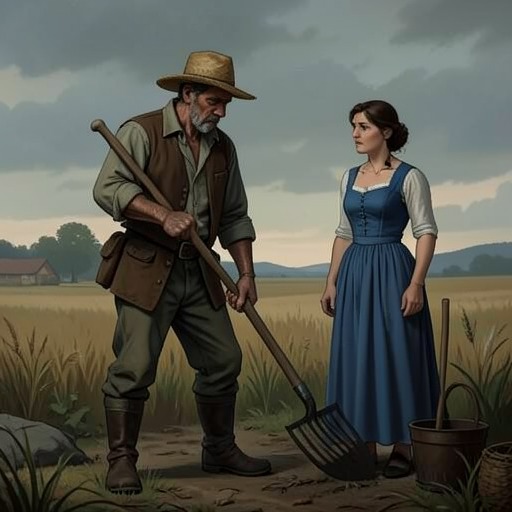
The harvest revel at Weatherbury Farm
Far from the Madding CrowdThe harvest revel at Weatherbury Farm brings the new marriage of Bathsheba Everdene and Sergeant Troy into public view, then exposes the cost of Troy’s control of the farm. What begins as a dance and harvest supper becomes a conflict over judgment and responsibility: Troy rejects Gabriel Oak’s warning about the weather and encourages the farm workers to drink, while Oak leaves the gathering and labors alone to protect the grain. The revel’s consequences reach beyond the night itself, setting communal festivity against the practical work on which the farm’s survival depends.
Causes and Setting
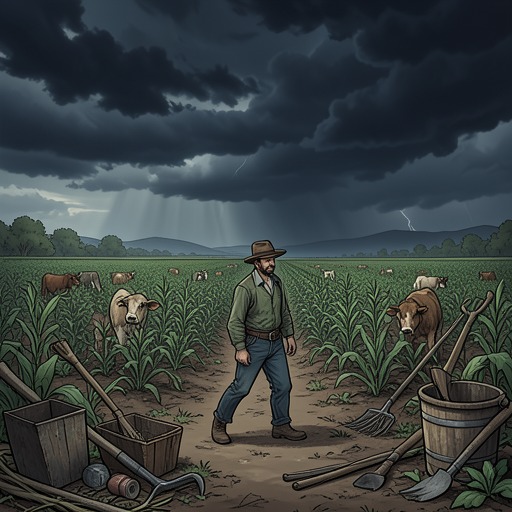
At the end of August, while Bathsheba’s experience of married life was still new, the weather gave Oak reason for alarm. The night sky looked ominous, and the sheep, rooks, and horses had behaved unusually. Eight uncovered ricks held a large part of the year’s produce, and Oak judged that an extended rain might seriously damage them. His concern was grounded in farm experience: the threat was not simply a change in the sky, but the possibility that valuable food and income would be lost if the grain remained exposed.
The gathering took place in the great barn, where the central floor and one end had been cleared for dancing, while oats were stacked at the far end behind sailcloth. Green branches decorated the walls and beams; fiddlers played from a platform, and the workers formed couples on the black oak floor. Bathsheba watched from behind a table of cups and food, with Troy beside her. The scene joined a seasonal farm celebration to a public announcement of the couple’s marriage, though Oak arrived carrying a very different concern: the eight ricks standing outside in the uncertain weather.
The Wedding Revel
The fiddler proposed “The Soldier’s Joy” in honor of Troy, who had purchased his discharge from the 11th Dragoon Guards and described himself as a soldier still in spirit. Troy took Bathsheba by the hand and led her into the dance. The choice of tune and his place at the head of the celebration made the marriage part of the evening’s public spectacle, in contrast to the farm work and seasonal risks that framed the gathering.
Oak tried to reach Troy with a warning that heavy rain was likely and that the ricks needed protection. Troy refused to interrupt his evening, dismissing the concern as needless fuss and saying that it would not rain. Oak left the barn, but paused when Troy addressed the guests. Troy announced that the occasion was not only a harvest home but also a wedding feast, and said that brandy and hot water would be brought round in strong drinks. Bathsheba asked him not to serve it, believing the workers had already had enough. Troy brushed aside her objection and proposed sending the women home so the men could continue drinking, adding that a man who refused could look elsewhere for winter work. Bathsheba indignantly left with the women and children; the musicians also departed, and Oak eventually left as well.
From Revel to Neglect
After the women and musicians had gone, Troy’s invitation and pressure turned the celebration into a drinking bout. The farm workers, accustomed to cider and mild ale rather than stronger liquor, became incapacitated within about an hour. Oak later looked back into the barn and found most of the able-bodied workers asleep in disarray; the celebration that had briefly gathered the farm community had left its workforce unable to protect the harvest.
Oak tried to obtain practical help even from those who were unconscious. He shook Matthew Moon and asked for the thatching tools; Moon named their location without waking. Oak also sought the granary key from Susan Tall’s husband, but received no answer. The scene makes the cost of the revel concrete: no one was available to assist with the work that the approaching weather made urgent. Oak put out the failing lights to prevent a barn fire, shut the door on the sleeping workers, and continued on his own.
The Night’s Work and Its Consequences
Before returning to the ricks, Oak studied the signs outside. A toad crossed his path; indoors, a slug left a shining trail across the table. He then checked the flock and found the sheep huddled together, facing away from the direction of the threatened storm. To Oak, these signs agreed with his knowledge of animal behavior and the changing weather. His assessment was more reliable than Troy’s confident dismissal, and the flock’s response strengthened his resolve to act.
Oak calculated that the five wheat ricks and three barley stacks represented about £750 in grain. He obtained the key to the granary and dragged out four waterproof cloths, covering two of the ricks and securing about £200 worth of produce. With no more cloth available, he improvised on another wheat stack by laying sheaves across its top and filling the gaps. He then began thatching the barley with spars. As the wind strengthened and the rain began, he continued working through the night, replacing thatch when it blew loose and protecting as much of the crop as he could.
By about seven in the morning, Oak had finished. The workers emerged from the barn awkwardly and ashamed, led by Troy, who whistled and did not turn to inspect the ricks. Oak had spent the night drenched and exhausted, but the work gave him the satisfaction of having succeeded in a good cause. The revel thus ends not in shared celebration but in an unequal aftermath: Troy and the workers leave the farm’s danger unattended, while Oak’s labor preserves a substantial part of Bathsheba’s harvest.
Significance
The episode draws a sharp contrast between two kinds of authority. Troy can command attention at the feast and pressure the workers into drinking, but he ignores the signs that matter to the farm and leaves the consequences to others. Oak’s authority is quieter and earned through attention: he interprets the weather, reads the flock, calculates the value at risk, and adapts his methods when the available materials run short. The danger to the ricks makes his practical knowledge consequential rather than merely descriptive.
The scene also reveals how Oak’s care for the farm and his feeling for Bathsheba overlap. He frames his decision as protection of property and food, yet his commitment to helping the woman he loves also underlies his effort. The harvest revel therefore turns a public celebration of Bathsheba’s marriage into a measure of what that marriage and Troy’s leadership mean for the farm: against the noise of the dance and the disarray of the drinking party, it is Oak who takes responsibility when the harvest is in jeopardy.